
The PSTN & ISDN Switch Off
Get ahead of the telecoms switch off. The telephone network as we know it is changing — and January 2027 is closer than you think.
Get ahead of the telecoms switch off

The Big Switch Off is a major milestone within the telecommunications industry, and although 2027 may seem far away, you need to start planning your move now to see how this could impact you and your business.
Remember, this switch off isn't just about phones. All analogue lines will be switched off, so you need to review everything connected to them, which could include alarms, payment terminals, fax and franking machines.
If you currently have older "Legacy" Broadband services such as ADSL or FTTC, both of which will have a supporting analogue telephone line, you will need to be upgraded to a new future proofed broadband product, such as SoGEA or FTTP.
There will be a one-off all-inclusive installation charge to cover hardware, re-programming, and any engineering time required in order to bring your new Broadband connection into service in a seamless manner, without any disruption.
What is the PSTN & ISDN Switch Off?
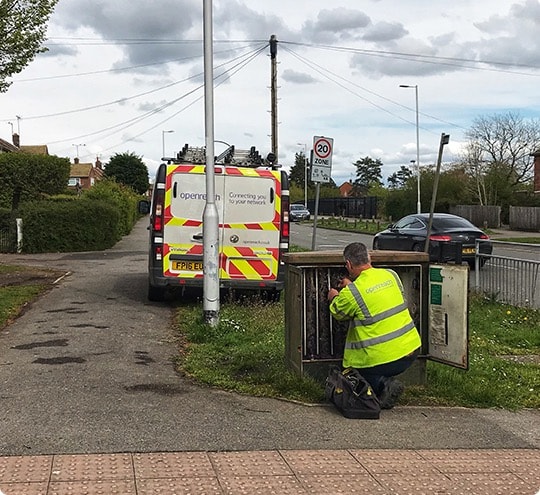
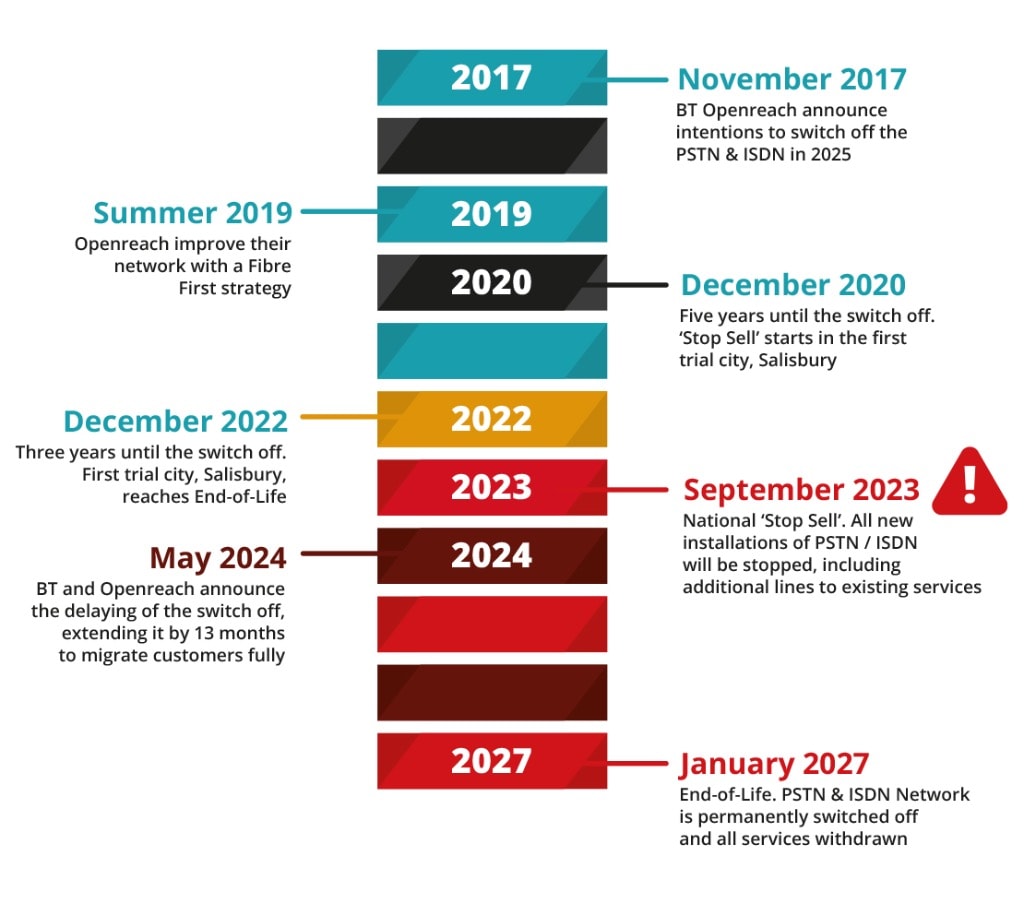
Openreach announced in 2017 that the PSTN (Public Switched Telephone Network) system is ageing and will reach its end-of-life by December 2025. In May 2024, they extended this deadline to 31st January 2027. From this point onwards, all businesses will need to have upgraded to a VoIP (Voice over Internet Protocol) phone system to be able to continue making calls, and upgraded any services which use analogue lines.
Though January 2027 is the final 'switch off' deadline, PSTN and ISDN services are being withdrawn across the country in phases, meaning this could impact you earlier than you expect. All new installations of PSTN and ISDN will be stopped from September 2023, and this includes adding additional lines to an existing PSTN / ISDN service.
What is PSTN & ISDN?
The Public Switched Telephone Network (PSTN) is what most would class as a traditional telephone line. It's an old technology, using the same setup as the first phone network from the 1800s. It's become increasingly costly to maintain and run, and needs replacing with more modern technology that is suitable for the world we live and work in today.
ISDN (Integrated Services Digital Network) was introduced in 1986, and while using the PSTN circuits, has allowed the digital transmission of voice calls, video calls and other data services simultaneously. It has become a more expensive network to maintain, and with it using the PSTN circuit, will also reach its end-of-life in 2027.
What is replacing PSTN & ISDN?

VoIP is the next generation for the country's telephone network. By January 2027, all businesses will need to upgrade their landline to a VoIP (Voice over Internet Protocol) phone system to continue making and receiving calls.
This switch off doesn't only affect phone systems. Any fax machines, alarms, CCTV systems, payment terminals, door-entry systems, information displays and emergency phones that currently use the older PSTN circuit will need to be updated by January 2027 too.
Customers will also need to upgrade their broadband to either FTTP (Fibre to the Premises) or a new broadband product called SOGEA (Single Order Generic Ethernet Access), which provides the ability to have broadband without a phone line.
What is VoIP?

VoIP (Voice over Internet Protocol) provides the ability to make and receive calls over an internet connection. It converts the voice communication into digital data that travels across the internet to its recipient.
VoIP allows calls to be made on any device that has a reliable internet connection, including smartphones and laptops. A VoIP phone system is much more flexible, as they can be provisioned remotely, meaning you can add additional lines to the system easily.
Call costs via VoIP are much cheaper when compared to traditional phone systems and usually come with innovative features.
Benefits of VoIP
Switching to VoIP isn't just about compliance — it's an opportunity to upgrade your communications and unlock powerful new capabilities.
Lower call costs
VoIP calls are significantly cheaper than traditional landlines, especially for long-distance and international calls.
Easy scalability
Add or remove lines instantly without an engineer visit. Scale your phone system as your business grows.
Work from anywhere
Make and receive calls on any device with an internet connection — office, home, or on the go.
Business continuity
Calls can be automatically rerouted to mobiles or other locations if your office is unavailable.
Advanced features
Voicemail to email, call recording, auto-attendant, hunt groups, and more — all included as standard.
Simple management
Manage your entire phone system from an easy-to-use online portal, with real-time reporting and analytics.
Ready to make the switch?
Don't wait until the deadline. Contact Unity Comms today and we'll guide you through a seamless migration to VoIP — with zero disruption to your business.